
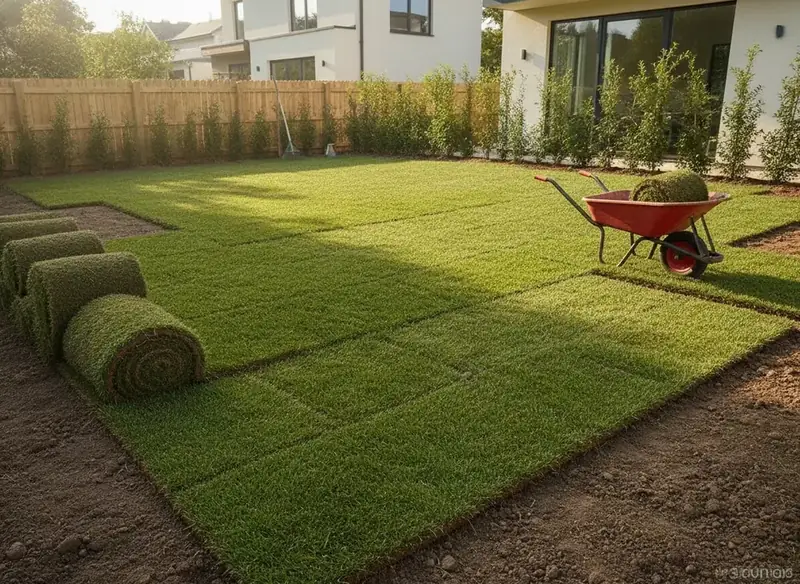
For most Lubbock lawns, bermudagrass and buffalograss are the strongest choices. Texas A&M AgriLife's Turfgrass Selection for Texas rates bermudagrass's drought tolerance as "very good to excellent" and says buffalograss is "best adapted for areas with annual rainfall of 25 inches or less." Lubbock averages 18.33 inches. Zoysiagrass also works anywhere bermuda does. St. Augustinegrass and tall fescue are poor fits here unless you are ready to water a lot more.
The right pick for your yard depends on sun, foot traffic, how much you want to mow and water, and how the lawn looks in winter. Here is how each grass does on the South Plains.
What a Lubbock lawn has to handle
- Little rain: 18.33 inches a year on NOAA's 1991–2020 normals, with January and February the driest months at 0.65 inches each (NOAA).
- Heat and cold: an average July high of 93.4 °F and an average January low of 27.2 °F, with a median freeze-free season of about 210 days.
- Watering limits: two assigned days a week under the City's schedule (see our Lubbock watering schedule).
- Alkaline soil: NRCS describes local soils such as the Amarillo, Acuff and Olton series as wind-laid and alkaline, with a calcium-carbonate (caliche-type) layer typically 30 to 60 inches down (NRCS Acuff series). Alkaline soil can cause iron chlorosis, a yellowing of the grass.
- Wind: spring is the windiest season, which dries out soil and new sod quickly.
Bermudagrass: the all-purpose choice
Bermudagrass is the grass most Lubbock homeowners picture: dense, fine to medium texture, and tough. AgriLife rates its drought tolerance "very good to excellent" and its traffic tolerance high, which makes it a strong fit for kids, dogs and backyard games. The trade-off is shade. Bermuda has very low to low shade tolerance, so it thins out under mature trees and on the north side of the house.
Care is straightforward but regular. AgriLife's E-242 says to mow common bermuda at 1 to 2 inches and hybrid bermudas at ½ to 1½ inches, never cutting more than one-third of the blade at a time, and to leave the clippings. Hybrids are mowed lower and more often, so they suit people who want a manicured look and do not mind the extra mowing. Bermuda goes brown and dormant after hard freezes and greens up again in spring.
The City of Idalou's drought-tolerant grass list names bermuda varieties including Celebration, GN1, Tex Turf, Tifway 419, Common, Grimes EXP and TifSport (City of Idalou).
Buffalograss: the low-water native
Buffalograss is native to the region. NRCS lists it, with blue grama, as part of the natural short-grass vegetation on Lubbock-area soils. AgriLife says it "does well as a low-maintenance lawn grass from Central to West Texas." It needs full sun and has little shade tolerance, and AgriLife suggests a mowing height of 2.5 to 3 inches.
The main warning is to avoid overwatering it. AgriLife notes buffalograss is invaded by weeds "when watered excessively," so it does poorly on a sprinkler schedule built for a thirstier lawn. It also has a softer, more natural look than a tight bermuda lawn, which some people love and others do not. Idalou's list includes "all varieties" of buffalograss among its drought-tolerant choices.
Zoysiagrass: a denser middle ground
AgriLife says zoysiagrass is adapted where bermudagrass is, and that it needs less nitrogen. It forms a thick, carpet-like lawn. The downside in a dry climate is that zoysia browns sooner than bermuda in extended drought. Idalou's drought-tolerant list includes El Toro, Empire, Jamur and Palisades zoysia.
St. Augustinegrass: a poor fit here
St. Augustine is common in Houston and San Antonio, which is why it shows up in Lubbock yards too. AgriLife calls it "less drought tolerant than bermudagrass or zoysiagrass," says it "may be killed by severe winters in the northern one-third of the state," and notes it can grow in West Texas only "with more supplemental irrigation." It is also the grass most susceptible to iron chlorosis on alkaline soil, according to the AgriLife/TCEQ guide GI-407, Managing Lawn Problems in Texas. On a two-day watering schedule, that is a hard combination.
Cool-season grasses: tall fescue, bluegrass and ryegrass
AgriLife says tall fescue's "use is limited to North Texas" and that it needs more summer irrigation than warm-season grasses. Kentucky bluegrass is "adapted in the Panhandle region… but requires irrigation." Perennial ryegrass in the High Plains "may be used as a permanent turfgrass if it is watered," but its most common use is overseeding a dormant bermuda lawn in late September or October for winter color.
Lubbock grass comparison
| Grass | Fit for Lubbock | Drought | Shade | Mowing height |
|---|---|---|---|---|
| Bermudagrass | Strong | Very good to excellent | Very low to low | 1–2 in. common; ½–1½ in. hybrid |
| Buffalograss | Strong (25 in. rain or less) | Excellent fit for low rainfall | Little | 2.5–3 in. |
| Zoysiagrass | Good | Browns sooner in long drought | Ask your supplier | Ask your supplier |
| St. Augustinegrass | Poor | Needs much more water here | — | — |
| Tall fescue | Poor | Needs more summer water | — | — |
Sources: AgriLife L-5519 and E-242. Dashes mean we have not listed a figure because the grass is not a good match for Lubbock lawns.
How to choose for your yard
Check the sun
Both bermuda and buffalograss want full sun. If big shade trees cover much of the yard, consider shrinking the lawn and using mulch or water-wise beds in the shade.
Think about traffic
Heavy play and pets favor bermuda's high traffic tolerance. A front yard that is mostly for looks can be a good spot for buffalograss.
Be honest about water and mowing
If you want to water as little as possible, buffalograss is the natural fit. If you want a golf-course look, a hybrid bermuda mowed low is the answer, with more mowing and feeding.
Decide how to plant
Sod gives an instant lawn and holds soil against spring wind; seed costs less but takes longer. Our sod vs. seed guide compares the two.
Getting quotes for a new lawn
Switching grasses usually means removing the old turf, preparing the soil and laying sod. Online cost guides report installed sod at about $1 to $3 per square foot in Lubbock, with bermuda sod material about $0.45 to $0.85 per square foot. Those are estimates, not quotes; see our Lubbock lawn care prices page for more. Lubbock Lawn Care Pros connects Lubbock-area homeowners with independent local lawn care, landscaping, sprinkler and tree companies for free, no-obligation quotes for sod installation, water-wise landscaping and regular mowing. Get a free quote and compare.