
To get rid of goatheads, remove or spot-treat the young plants before they flower and set their spiny burs, pick up the burs already on the ground, and thicken your lawn so new seedlings get shaded out. Plan on repeating this for several seasons. Goathead seeds stay viable in the soil for years (Ask Extension), and pre-emergent herbicides are "not very effective" against their large seeds (City of Albuquerque research summary). The win comes from stopping each new crop before it reseeds.
What goatheads are
Goatheads are the common name for puncturevine (Tribulus terrestris), a low, spreading weed whose seed pods dry into hard, sharp burs that end up in bike tires, pet paws and bare feet. New Mexico State University Extension describes it as a summer annual: the plants die in fall and come back from seed each spring or early summer (NMSU). Texas A&M AgriLife's Lubbock research center keeps an identification page for puncturevine if you want to confirm what you are looking at.
Because the plant is an annual, the only way it returns next year is through seed. That is the key to the whole plan: every plant you remove before it sets burs is one less source of seed banked in the soil.
Why goatheads show up in Lubbock yards
Goatheads favor open, disturbed ground: thin turf, bare patches along sidewalks and driveways, alley edges and spots where the grass died back in a dry spell. Lubbock's climate creates plenty of those openings. NOAA's 1991–2020 normals for Lubbock Preston Smith International Airport show just 18.33 inches of precipitation a year and an average July high of 93.4 °F (NOAA monthly normals). A lawn that goes thin in July hands the weed exactly the bare, sunny soil it needs.
The flip side is the most useful finding in the extension literature: dense, healthy turf outcompetes goatheads (Ask Extension). Treating the weed without fixing the thin grass usually means fighting the same patch next summer.
Step 1: Catch them young (when is goathead season?)
Seedlings appear in spring and early summer, and new flushes can keep coming through the warm months. Walk the lawn edges, beds and bare spots every week or two from late spring on. Young plants are small, flat rosettes of fine, divided leaves; once you see small flowers, burs are not far behind. Your goal is to act in that window between sprouting and seed set.
Step 2: Pull or hoe small patches
For a handful of plants, hand removal is hard to beat. Grab the plant at its center and pull up the taproot, or slice it just below the soil with a sharp hoe. If plants already carry green or brown burs, bag them rather than tossing them in the compost or leaving them on the lawn, where the burs drop and reseed the spot.
Step 3: Spot-treat larger infestations while plants are young
Extension guidance is to treat young plants with a post-emergent herbicide before they set seed (Ask Extension). A few cautions for Lubbock lawns:
- Read the label. Make sure the product lists puncturevine (or broadleaf weeds generally) and is labeled safe for your grass type.
- Watch the heat. Texas A&M AgriLife's bermudagrass guide notes that broadleaf herbicides such as 2,4-D, MCPP or dicamba can injure bermuda when temperatures are above 95 °F, so apply early in the morning or in the evening (AgriLife E-242).
- Spot-treat, don't blanket. Goatheads tend to cluster along edges and bare patches, so a targeted spray uses less product than a whole-yard treatment.
Weed-and-feed products contain herbicide, so they count as a pesticide application too. If you would rather hire it out, keep the state rule in mind:
In Texas, anyone who applies weed killers, insect or grub control, or other pesticides to a lawn for hire must hold a Texas Department of Agriculture (TDA) applicator license. Fertilizer-only applications do not require one. Before you hire, ask for the company's TDA license number and verify it with TDA.
Our post on Texas lawn care license rules explains what to ask for and where to check it.
Step 4: Pick up the burs already on the ground
Burs that have already dropped are next year's crop. Rake bare areas and walkways, sweep driveways and sidewalks, and check gravel beds. A common trick is to drag an old piece of carpet or a heavy towel across the area; the burs stick to it and you can shake them into a trash bag. Do this in late summer and fall, after the plants dry out and before the burs work their way into the soil.
Step 5: Thicken the turf so goatheads can't get started
This is the long-term fix. A few AgriLife basics for bermudagrass lawns (E-242):
- Mow at the right height. Common bermuda at 1–2 inches, hybrids at ½–1½ inches, never removing more than ⅓ of the blade at once. Leave the clippings.
- Feed after green-up. Soil-test first, then fertilize once late frost is unlikely, using about 1 pound of soluble nitrogen per 1,000 sq ft every 4–6 weeks (or 1½ pounds of slow-release every 8–10 weeks).
- Water deeply, not daily. Follow your assigned watering days and the City's guidance. Our Lubbock watering schedule guide covers the details. Check the current schedule and any drought stage at mylubbock.us before you set your controller.
- Fill the bare spots. Patch thin areas with sod or seed so there is no open soil left for seedlings. See sod vs seed in Lubbock for the trade-offs.
What about pre-emergent?
Pre-emergent herbicides work well on many small-seeded summer weeds such as crabgrass, but research summarized by the City of Albuquerque found them "not very effective" on goatheads because the seed is so large (Albuquerque research summary). A spring pre-emergent can still be part of a broader weed plan, just don't count on it to solve a goathead problem. Our guide on when to apply pre-emergent in Lubbock covers timing for the weeds it does control.
A goathead plan by season
| Season | What to do |
|---|---|
| Late winter to early spring | Plan repairs to thin areas; schedule any pre-emergent for other summer weeds. |
| Spring to early summer | Scout weekly for seedlings; pull or spot-treat while plants are small. |
| Mid to late summer | Keep removing plants before burs mature; bag any plants carrying burs. |
| Fall | Plants die back. Rake and drag up fallen burs from bare areas and walkways. |
For the rest of the year's lawn tasks, see our Lubbock lawn care calendar.
Getting help with goatheads
If the patch is large or keeps coming back, a local weed control company can scout, spot-treat and pair the treatments with mowing and fertilization that thicken the lawn. You can compare options on our weed control in Lubbock, lawn fertilization and lawn maintenance pages. For a sense of cost, online cost guides (2025–2026) report weed-and-feed applications at about $105–$325 each (a national range); these are estimates, not quotes. See our Lubbock lawn care prices page for more ranges.
Lubbock Lawn Care Pros is a free quote service. We connect Lubbock-area homeowners with independent local lawn care companies for free, no-obligation quotes. The company you choose sets its own prices and does the work. When you are ready, request a free quote and describe where the goatheads are growing.
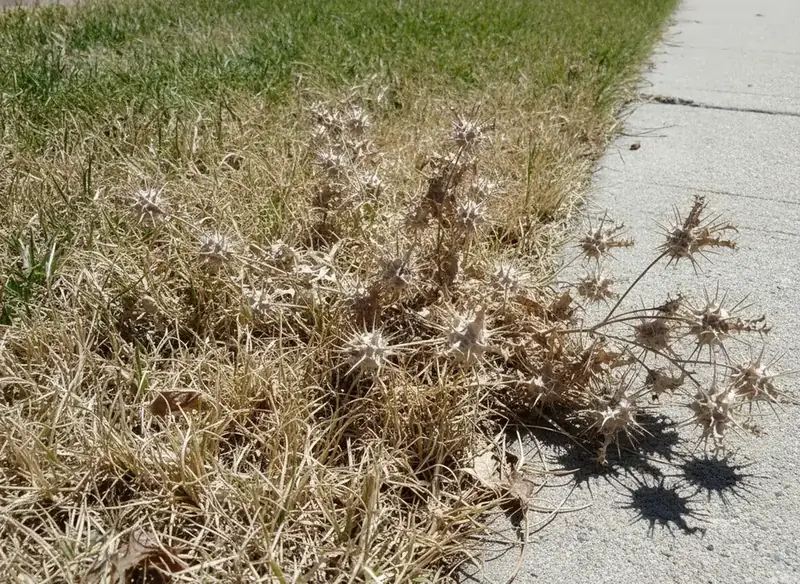
Thin turf by a sidewalk is where many summer weeds get a foothold. Thickening the grass is the longest-lasting fix.