
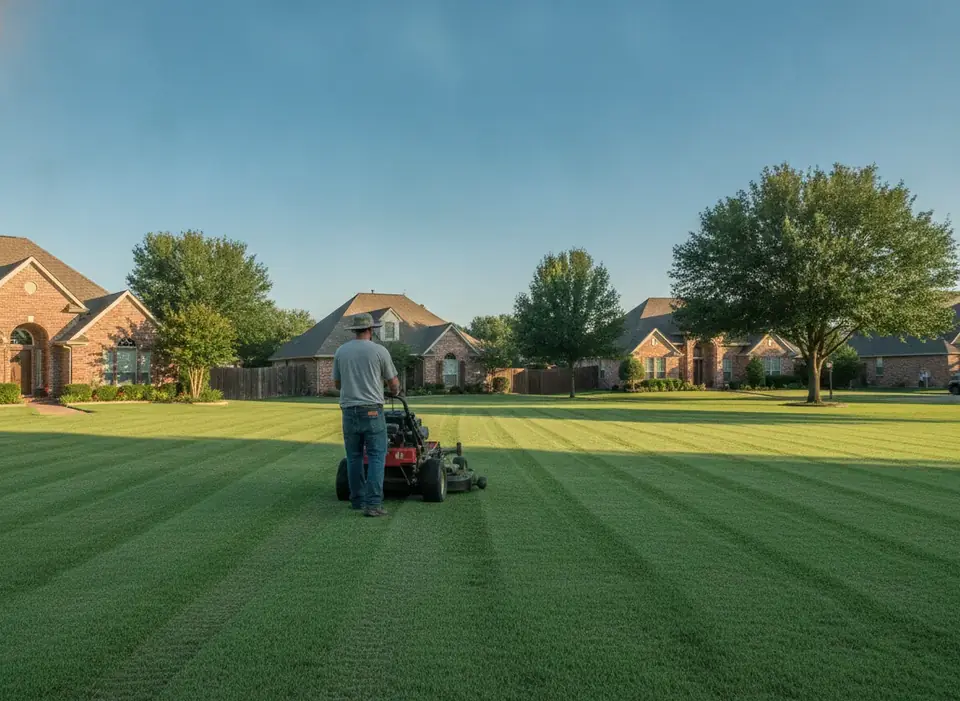
A Lubbock lawn care calendar follows the warm-season grasses that grow here. Late winter is for planning and pre-emergent weed control. Bermuda greens up in April, after the median last freeze on April 4. May and June are the main months for feeding, mowing, dethatching and new sod. August is the window for grub control. September is the time to stop fertilizing bermuda, and November's first freeze sends the lawn into winter dormancy. The month-by-month guide below is built on Texas A&M AgriLife guidance and NOAA climate normals for Lubbock.
Dates shift with the weather each year, so use the months as a guide and watch the lawn itself.
January and February: dormant season
Bermuda and buffalograss are brown and dormant. January and February are Lubbock's driest months, at 0.65 inches each on NOAA's 1991–2020 normals (NOAA), with an average January low of 27.2 °F.
- Water only if the soil is very dry, on your assigned day, when it is above 35 °F. City Code makes it an offense to irrigate during freezing weather or precipitation.
- Do not fertilize bermuda. AgriLife's E-242 says not to fertilize bermudagrass from September through February unless it has been overseeded.
- Get the mower serviced and the blade sharpened before spring.
- Late February is when to plan pre-emergent weed control. Our pre-emergent timing guide covers the details.
March: pre-emergent and spring cleanup
Spring is the windiest season in Lubbock, and March kicks it off. Pre-emergent herbicide goes down in late winter to early spring, before weeds germinate, following the product label. AgriLife gives two signals: soil at about 65 °F in E-242, and crabgrass germination once 2-inch soil reaches about 55 °F for three days (AgriLife Today).
- Rake out leaves and debris blown in over winter. A yard cleanup is a common spring job.
- Run each sprinkler zone and check for broken heads before the April watering hours start.
- Hold off on fertilizer. AgriLife says to wait until after green-up, when late frost is unlikely.
April: green-up
NOAA's median last spring freeze at Lubbock's airport is April 4, but in 1 year in 10 it comes after April 22 (NOAA annual normals). The City's spring and summer watering guidance starts April 1, with hours of midnight to 10 a.m. or 6 p.m. to midnight on your two days (see our watering schedule guide).
- Start mowing at green-up. AgriLife says to mow common bermuda at 1 to 2 inches, hybrids at ½ to 1½ inches, and buffalograss at 2.5 to 3 inches.
- Do a soil test. AgriLife recommends one before the first fertilizer.
- Watch for circular dead patches that stay brown while the rest of the lawn greens. That can be spring dead spot (see why bermuda turns brown).
- The Lubbock area's main severe-weather season runs from early April into early July (NOAA Storm Prediction Center).
May: first feeding and lawn repairs
May is Lubbock's wettest month, averaging 2.69 inches. It is a good month for most lawn work.
- Fertilize bermuda once it has fully greened up and late frost is unlikely. E-242 suggests 1 pound of soluble nitrogen per 1,000 square feet every 4 to 6 weeks, or 1½ pounds of slow-release nitrogen every 8 to 10 weeks.
- Dethatch if the thatch layer is over ½ inch. AgriLife says May is the time to vertical-mow bermuda.
- Core-aerate while the grass is actively growing, and flag sprinkler heads first.
- Lay new sod while the grass is actively growing, and keep it watered as it roots.
June: peak growth
June averages 2.58 inches of rain and a 91.6 °F high. Bermuda grows fast, and search interest in lawn care in Lubbock peaks in June and July.
- Mow often enough that you never remove more than one-third of the blade, and leave the clippings.
- Keep feeding on schedule. E-242 gives 1 to 1½ pounds of nitrogen per 1,000 square feet every 4 to 10 weeks from June through August.
- Spot-treat broadleaf weeds early in the day. AgriLife warns that 2,4-D, MCPP and dicamba can injure bermuda above 95 °F.
- Look for goatheads in thin spots and along sidewalks (see how to get rid of goatheads).
July: heat management
July is the hottest month, with an average high of 93.4 °F. Focus on deep, infrequent watering. AgriLife suggests wetting the soil to about 6 inches and then waiting for drought-stress signs, usually 5 to 10 days. Use cycle-and-soak to stop runoff, and check coverage if brown arcs appear.
August: grubs and the last summer feeding
E-242 says "the most effective time to treat for white grubs is in August." If you have had grub damage before, this is the month to ask about it. It is also the last month for the summer nitrogen schedule.
September: wind down and prevent spring dead spot
September brings 2.55 inches of rain on average. Stop fertilizing bermuda this month unless you overseed. If spring dead spot showed up last spring, the Texas Plant Disease Handbook says fungicide treatment "must begin in late summer or early fall" (Texas Plant Disease Handbook). If you want winter color, AgriLife notes perennial ryegrass is used to overseed bermuda in late September through October.
October: fall schedule and leaves
The City's fall and winter watering rules start October 1: same two days, and only above 35 °F. NOAA gives a 10% chance of a first freeze by October 19. Keep mowing at normal height as growth slows, and mulch or rake leaves before they mat on the grass.
November: dormancy
The median first fall freeze is November 2. Bermuda and buffalograss turn tan and go dormant, which is normal. The City recommends winterizing your sprinkler system and installing a rain and freeze sensor. A last fall yard cleanup clears leaves before winter wind spreads them.
December: rest and plan
December averages 2.4 inches of Lubbock's 7.0 inches of annual snow. Keep traffic off frozen turf, water only if it is very dry and above 35 °F, and line up spring quotes before the growing season starts.
Treatments and Texas license rules
Several jobs on this calendar, including pre-emergent, broadleaf weed control, grub control and spring dead spot fungicide, are pesticide applications when someone does them for hire. Our Texas lawn care license guide explains more.
Texas pesticide rule: In Texas, anyone who applies weed killers, insect or grub control, or other pesticides to a lawn for hire must hold a Texas Department of Agriculture (TDA) applicator license. Fertilizer-only applications do not require one. Before you hire, ask for the company's TDA license number and verify it with TDA. Weed-and-feed products contain herbicide, so they count as a pesticide application. This is general information, not legal advice.
Hand off some of the calendar
Lubbock Lawn Care Pros connects Lubbock-area homeowners with independent local lawn care, landscaping, sprinkler and tree companies for free, no-obligation quotes for weekly lawn mowing, seasonal fertilization, weed control and cleanups. Online cost guides put weekly mowing or maintenance at about $50 to $150 per visit. That is an estimate, not a quote; see Lubbock lawn care prices. When you are ready, request a free quote.